The United States Of America, the shining city on the hill that defines what a society of free people is. Innovators, inventors, revolutionists, adventurers and those that dare.
Now we stand on the cusp of a great time, just days away from the celebration of our great nation’s 250th anniversary.
All things considered the United States of America is a relatively young nation. Yet we have soon become one of the oldest forms of continuous systems of government. Standing amongst ancient empires that have shifted across the centuries into what they are today.
Retrospectively, the United States has led the charge in numerous fundamental parts of the modern world. Being the first to establish a democratic nation, whose citizenry have given rights and freedoms at birth, to pursue life, liberty and happiness. We were the first in flight with the Wright brothers, and soon after to the moon on the Apollo missions. We cared for our land enough to preserve it, establishing the world’s first national park. Created the first skyscrapers to reach into the heavens, and even the foundation of the world wide web. The world’s first to create a self sustaining nuclear chain reaction, establishing nuclear power on an industrial scale.
The United States has quickly risen to the top in a global way, we define trends, policy and fiscal action that the majority of the world begins to take into consideration for their own governments soon after.
I am writing this not to disparage the continuity of our nation, but to highlight a core part of this country’s success that we have seemed to have forgotten. That core is soil, and everything that depends upon it. The agricultural system of America is a powerhouse, we are currently the 3rd largest producer of food in the world, but that system comes at a cost.
From the early 1900s the mechanization of agriculture allowed for our effect on the land to exponentially increase. This brought forth increased productivity but led to an exasperation of the soil throughout our primary areas of production. Only 30 years had passed with this method before drastic consequences began to take place.
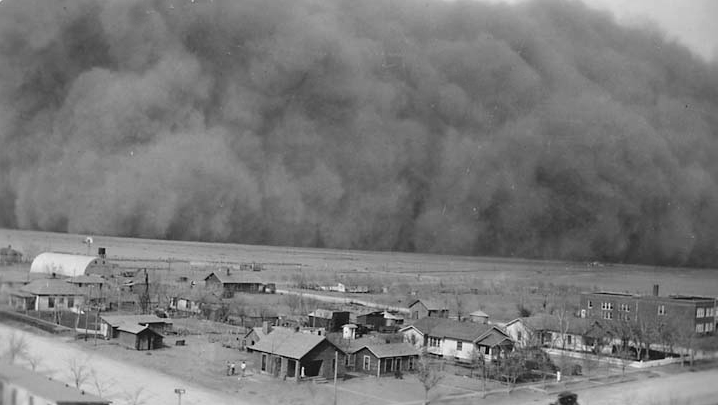
We refer to one of those consequences as the Dust Bowl, a period from 1930-40 where rapid aridification over almost 125 million acres occurred. Our topsoil throughout the midwestern region had begun to rapidly die off, ceasing its ability to hold water, life and productivity, becoming a wasteland of sand and dust, inches of soil were lost each year.
To put things in perspective it takes a natural series of events roughly 500 years to restore just an inch of soil.
It was estimated at its peak in 1935 that roughly 850 million tons of topsoil blew off from the southern plains. Forming massive dust storms that plagued the rest of the continental United States. Destitution became a sign of the times as most labor back then was centered around agriculture and there was none to be had, and little food following the harvests.
George Washington Carver who pioneered many forms of crop rotation and soil stewardship famously wrote “Wherever the soil is wasted the people are wasted. A poor soil produces only a poor people — poor economically, poor spiritually and intellectually, poor physically.” to elaborate on the importance that a soil is truly the foundation of a nation’s quality, not its people who depend upon it.
During the Dustbowl president Franklin Delano Roosevelt championed a movement towards the support and saving of our food system and the backbone of society that maintains it. He established in 1933 a temporary funding for Soil Erosion Service and signed into effect the Soil Conservation Act in 1935, declaring soil health a matter of Federal importance.
F.D.R said “The Nation that destroys its soil destroys itself.”
Millions were spent lining crop fields with trees to shield from wind storms and lock the soil within their areas, while also anchoring water and root activity around their fields. Educational campaigns went out to discuss the effects of leaving lands bare and exposed to the sun, or the overuse of tillage and in a few years the erosion rate began to decrease as a sign of all the cumulative efforts.
Today our cropland loses a combined average of 4.75 tons of soil per acre annually when combining wind and water erosion. During the dust bowl it was calculated at an average of 480 tons per acre lost annually. The decade of the dustbowl lost roughly a century’s worth of soil! The effects of FDR’s campaign to restore soil stewardship was astronomically successful in comparison and quite frankly saved the nation.
However all is not roses, our current soil erosion rates are averaging 1,480% faster than the natural restoration rate of topsoil from nature. We are still losing topsoil far faster than it is being replenished. We take it for granted because it is all around us, but our planet has spent eons building itself to get to the point it is now, these soils existed far before humanity ever did. Soil is a natural resource of our planet and it is one of the most rapidly depleted ones at scale of replenishment, more than our aquifers and even forests. We are rapidly using up our supply!
The United States of America has a history of accomplishing great feats, seemingly impossible tasks and leading the world in its decisions. We cannot hope to continue taking from a system without finding a means to give some parts back to it. Strides have already been made in the right direction. Regenerative agriculture and land stewardship has only risen throughout the years but the fact remains that we are losing soil, and if we wish to continue on another 250 years we should be keen on rebuilding it.